
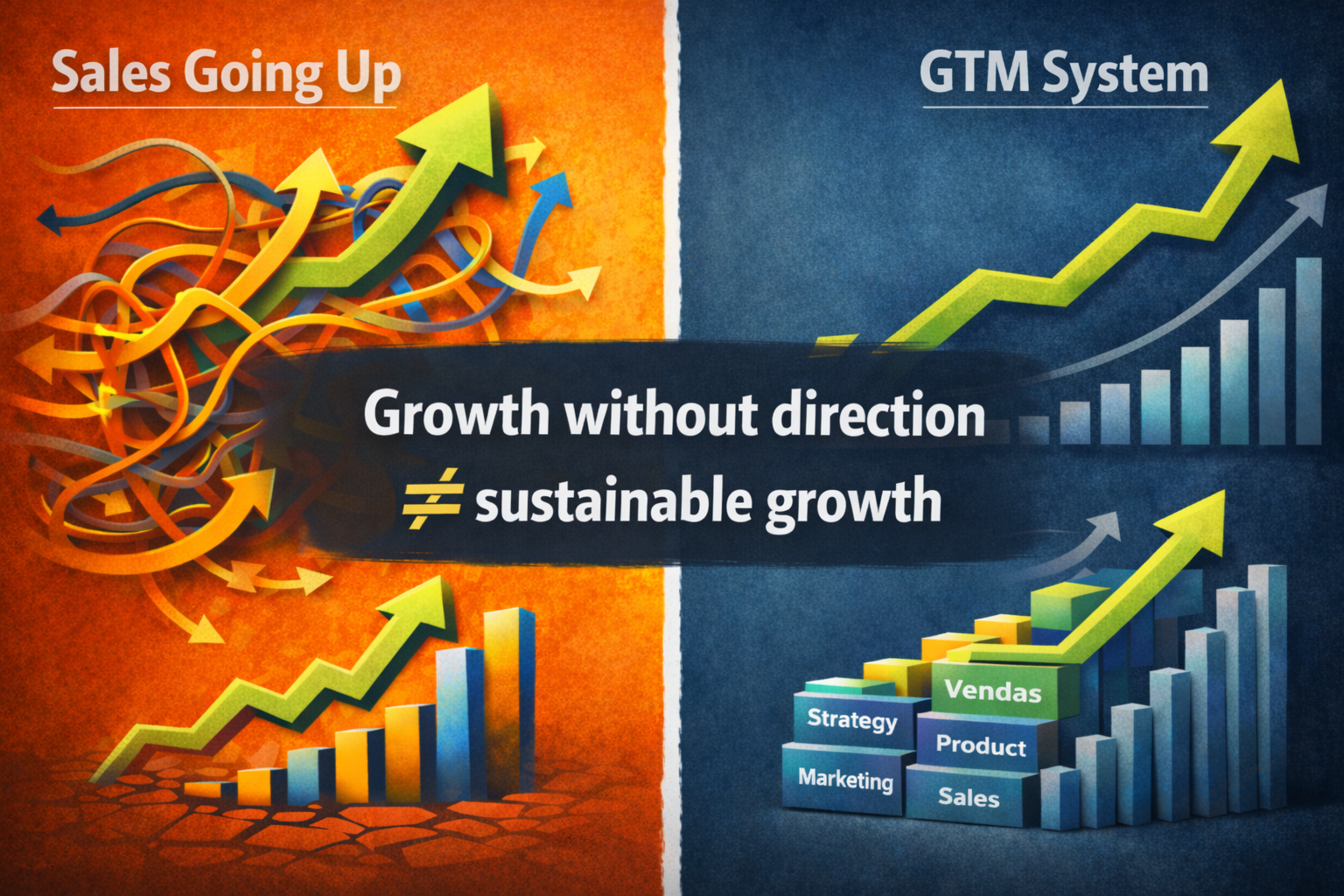
Have you ever felt like your company is growing… but in the wrong direction? It’s a strange feeling: sales are going up, there’s activity, but something doesn’t quite fit. That’s exactly what made me realize that growing without a Go-To-Market strategy is like building a house without a blueprint, you might end up with a roof, but the walls will be crooked.
What is a Go-To-Market Strategy?
First, it’s worth aligning on the concept. A Go-To-Market strategy is the plan that defines how a product or service is brought to market, how it reaches the right customers, and how it consistently generates value.
It’s not just about marketing. It’s much more than that.
An effective GTM strategy connects the product, the ideal customer, the positioning, the value proposition, and the acquisition channels into a single strategic direction. That’s what ensures sales, marketing, and operations are aligned, rather than each area moving in its own direction.
And this is exactly where many companies fail.
They confuse marketing with Go-To-Market.
Marketing is part of the execution. The Go-To-Market strategy is the system that defines who the company exists for, what problem it solves, how it differentiates, and how it turns that relevance into revenue.

In simple terms, marketing is one piece of the puzzle. The Go-To-Market strategy is the entire puzzle.
A estrutura por trás do crescimento sustentável
Companies that grow consistently rarely do so by improvisation. There is a method.

A well-structured Go-To-Market strategy answers fundamental questions:
- Who is your ideal customer?
- What specific problem are you solving?
- How is your product different?
- Why should someone buy from you?
- How are you going to reach those people?
Without clear answers to these, you’re basically throwing darts in the dark and hoping to hit the target.
How to create a Go-To-Market strategy
If you’re thinking about how to create a Go-To-Market strategy, start here:

- Define your ICP (Ideal Customer Profile) — who they are, what pains they have, and where they are.
- Map the problem — what specific pain does your product solve?
- Position yourself — how do you differentiate from the competition?
- Choose your channels — where is your customer? LinkedIn? Email? Events?
- Test and iterate — no strategy is perfect from day one.
Growth in B2B happens when these pieces are aligned: customer, positioning, messaging, channel, and sales process.

When they’re not, a company may still grow, but it does so without clear direction, with higher costs and less predictability.
This is where many companies fail.
They have a solid product, there is real value in the market, but there’s a lack of clarity about who should buy, why they should buy, and how to reach those accounts consistently.
Without a Go-To-Market strategy, growth turns into improvisation.
And in a B2B context, where sales cycles are longer and decisions involve multiple stakeholders, that lack of alignment translates into an inconsistent pipeline, higher CAC, and wasted time.

In the end, it’s not just about growing.
It’s about growing with direction, efficiency, and the ability to turn demand into predictable revenue.
